When Instagram Changed Its Rules: Recovering a Six-Platform Content Engine
The Problem
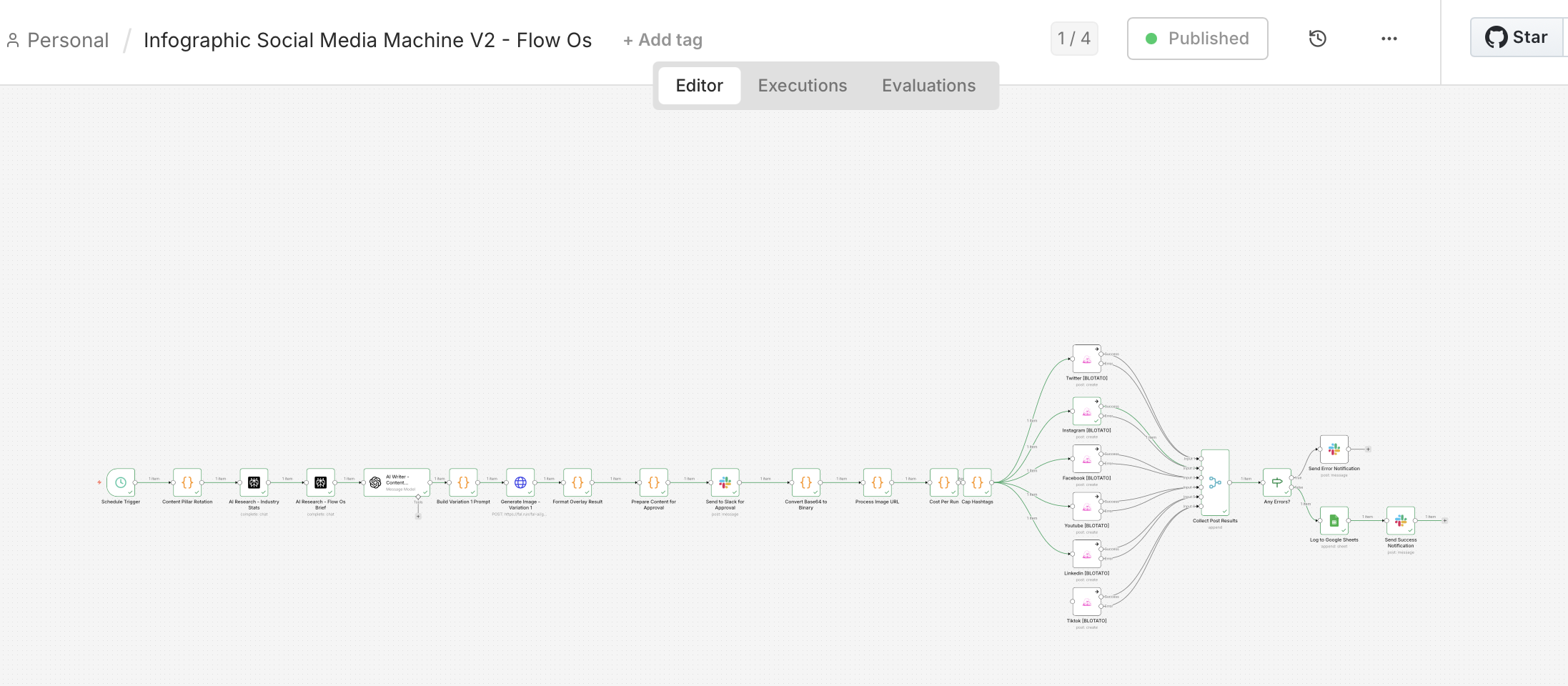
For months, the Flow OS content engine ran on autopilot. Every three days, it generated an on-brand infographic and published it to six platforms with platform-specific captions. No human touch required.
Then it broke. Not loudly — silently. The pipeline still ran. The image still generated. The captions still wrote themselves. But two of the six platforms quietly started rejecting every post with a generic, useless error: “Your request is invalid.”
That’s the kind of failure that’s worse than a crash. A crash is honest. A silent failure is a workflow that looks healthy in dashboards while quietly missing every Instagram post for weeks.
What We Built
The investigation surfaced something bigger than a single bug: three separate platform API specifications had quietly tightened in a single quarter. Image format requirements. Aspect ratio enforcement. Hashtag count limits. Each one was a small change in isolation. Stacked on top of an automation that depended on all three, they created a slow-rolling outage.
We diagnosed the actual root cause — Instagram’s late-2025 enforcement of a hard five-hashtag limit on Graph API publishing — shipped two fixes to production, and added a code-level safety net that protects against the same failure pattern recurring on the other five platforms.
Total time from “it’s broken” to “shipped, tested, and committed” was roughly 90 minutes. More importantly, the architecture now treats platform spec changes as expected, not exceptional.
Tech Stack
- n8n (self-hosted) — orchestrates the full content pipeline across six platforms
- Claude (architecture) + Claude Code (execution) — the diagnosis-and-build pattern that drives every Flow OS infrastructure session
- FAL Gemini 2.5 Flash Image — generates the on-brand infographic from a structured prompt
- OpenAI GPT-4o — writes the six platform-specific captions in one pass
- Perplexity Sonar Pro — pulls current industry research to ground each post in real data
- Blotato — handles the actual posting to Twitter, Instagram, Facebook, YouTube, LinkedIn, and TikTok
- GitHub + DigitalOcean — version-controlled workflow files on a self-managed droplet, with rollback artefacts on every patch
Key Decisions
Belt-and-braces over single-point fixes
When the root cause turned out to be Instagram’s five-hashtag enforcement, the obvious fix was to update the AI prompt to instruct the language model to generate exactly five hashtags. That works — until the model has a creative day and produces six. LLMs drift.
So we shipped two fixes, not one: the prompt update, and a deterministic Code node that hard-trims any caption to the first five hashtags before it reaches Blotato. Prompt change is the polite ask. Code node is the contract. Both ship together because we trust contracts more than asks.
Keep useful patches even when they’re not the root cause
Early in the diagnosis we identified that Instagram’s API now strictly rejects PNG image uploads — another recent enforcement change. We patched the workflow to force JPEG output from the image generator before realising the actual error came from somewhere else. The PNG fix stayed shipped. Removing a future failure mode — even one we haven’t hit yet — is cheap insurance. Reverting it just to keep a clean changelog is the wrong trade.
Architectural insight: spec drift is the new default
Three platform spec changes hit one workflow in one investigation. PNG. Aspect ratio. Hashtag limits. The lesson isn’t “Meta is annoying” — it’s that any pipeline depending on a platform API will face this regularly, and the durable answer is a normalisation layer between the AI generation step and the posting step. Not just for this workflow. For every client pipeline Flow OS will build.
That insight is now load-bearing for the broader infrastructure roadmap — a single conformance microservice that takes raw AI output and returns platform-spec’d output, called once per platform, owns the hard rules so the pipelines don’t have to.
Outcomes
Time recovered. The content engine generates an infographic plus six platform-specific captions and publishes to six platforms in under two minutes. Done manually, the equivalent work — research, copywriting, design, six separate uploads — runs two to three hours per cycle. At ten cycles per month, the engine returns roughly 25 hours of marketing operations to the business. The equivalent of a part-time marketing assistant, running on a few cents of compute per cycle.
Resilience added. The Cap Hashtags node now sits in the pipeline as a permanent guard against AI drift. Any caption with more than five hashtags gets trimmed deterministically, regardless of what the language model generates. A _hashtagCapApplied breadcrumb in every execution makes the safety net visible in observability.
Full audit trail. Three commits to the infrastructure repository, two rollback artefacts on disk, and detailed entries in the build log. Every change to production infrastructure leaves a trace that’s reversible.
Recovery time: ~90 minutes from problem identified to fix shipped, tested, and version-controlled. For a multi-layer issue spanning three vendors, that’s the kind of speed that’s only possible with a tight architecture-and-execution loop.
What I’d Do Differently
Test in the destination platform first. The breakthrough diagnostic came from manually posting the failed content directly in Blotato’s UI — which surfaced the platform error message that the API had been swallowing into a generic “invalid request.” Vendor APIs often lie about what’s wrong; vendor UIs usually tell the truth. That’s the move I’ll reach for first next time, not last.
Build the normalisation layer once, not patch six times. The conformance microservice was already on the infrastructure roadmap before this session. After this session, it’s the next build, because every future client pipeline benefits the moment it ships. Patching individual workflows reactively is fine for a one-off; for a pipeline-as-a-service business, it’s the wrong unit of work.
Monitor for silent failures. The pipeline kept appearing to run for weeks before anyone noticed it was silently dropping Instagram posts. A simple “did Instagram receive a post in the last cycle?” check would have caught this within 72 hours instead of several weeks. Already on the next sprint.
Assets
- Flow OS — the platform this engine markets
- Flow OS on Instagram — where the recovered engine now posts every three days
- Flowstates Collective
Built by Tyson Venables — Flow OS | Flowstates Collective