Emma Maidment AI Advisor Platform
The Problem
Emma Maidment had two Custom GPTs on ChatGPT — Story Strategist™ and Magnetic Authority™ — built around her signature coaching methodologies for health entrepreneurs. They were working well enough that beta users were asking to pay for access, even as a free ChatGPT tool. But the experience was completely locked inside OpenAI’s ecosystem: no branding, no monetisation, no analytics, no ownership. Emma had real IP sitting in a platform she didn’t control, with no way to turn it into a revenue stream.
What We Built
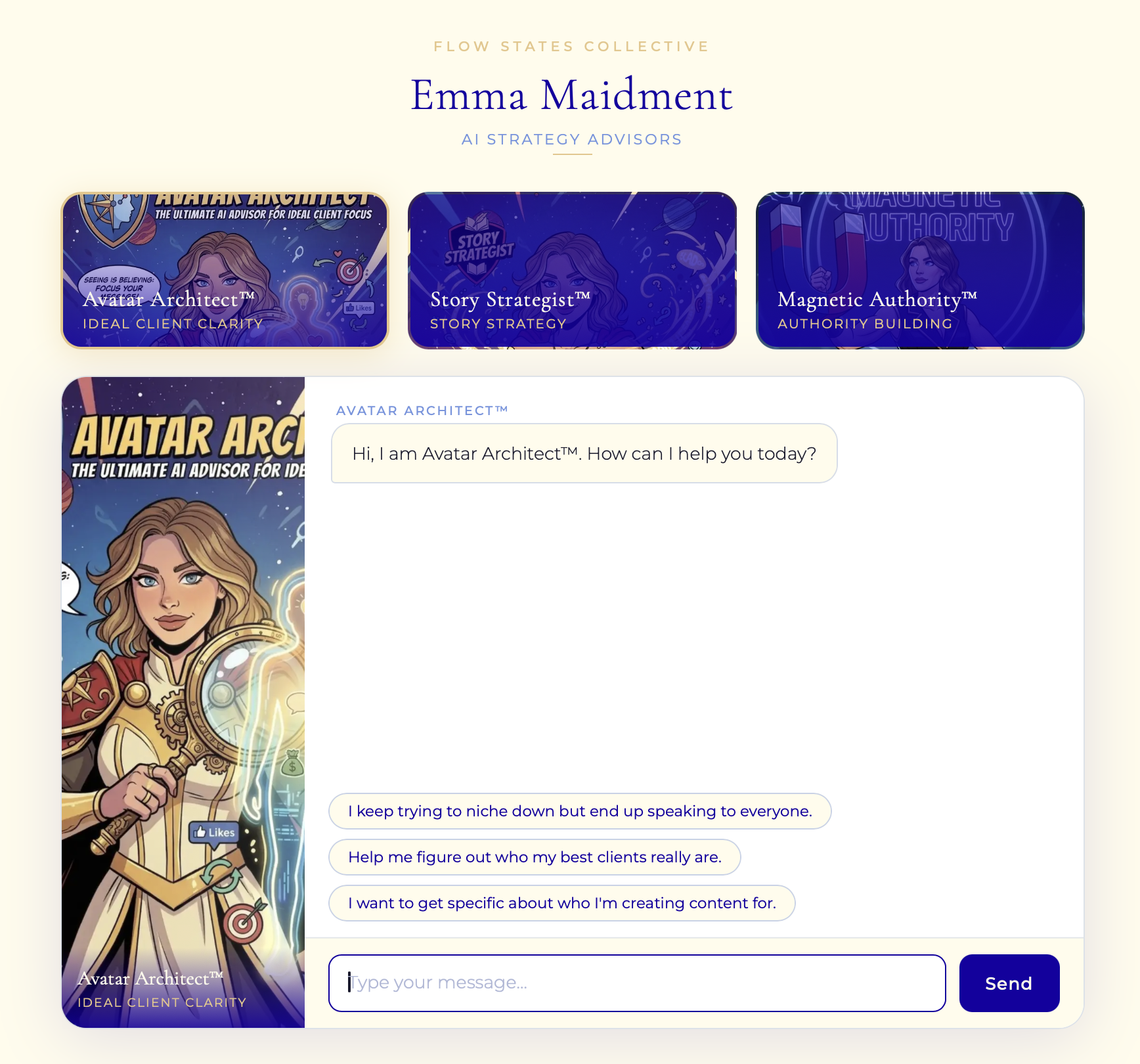
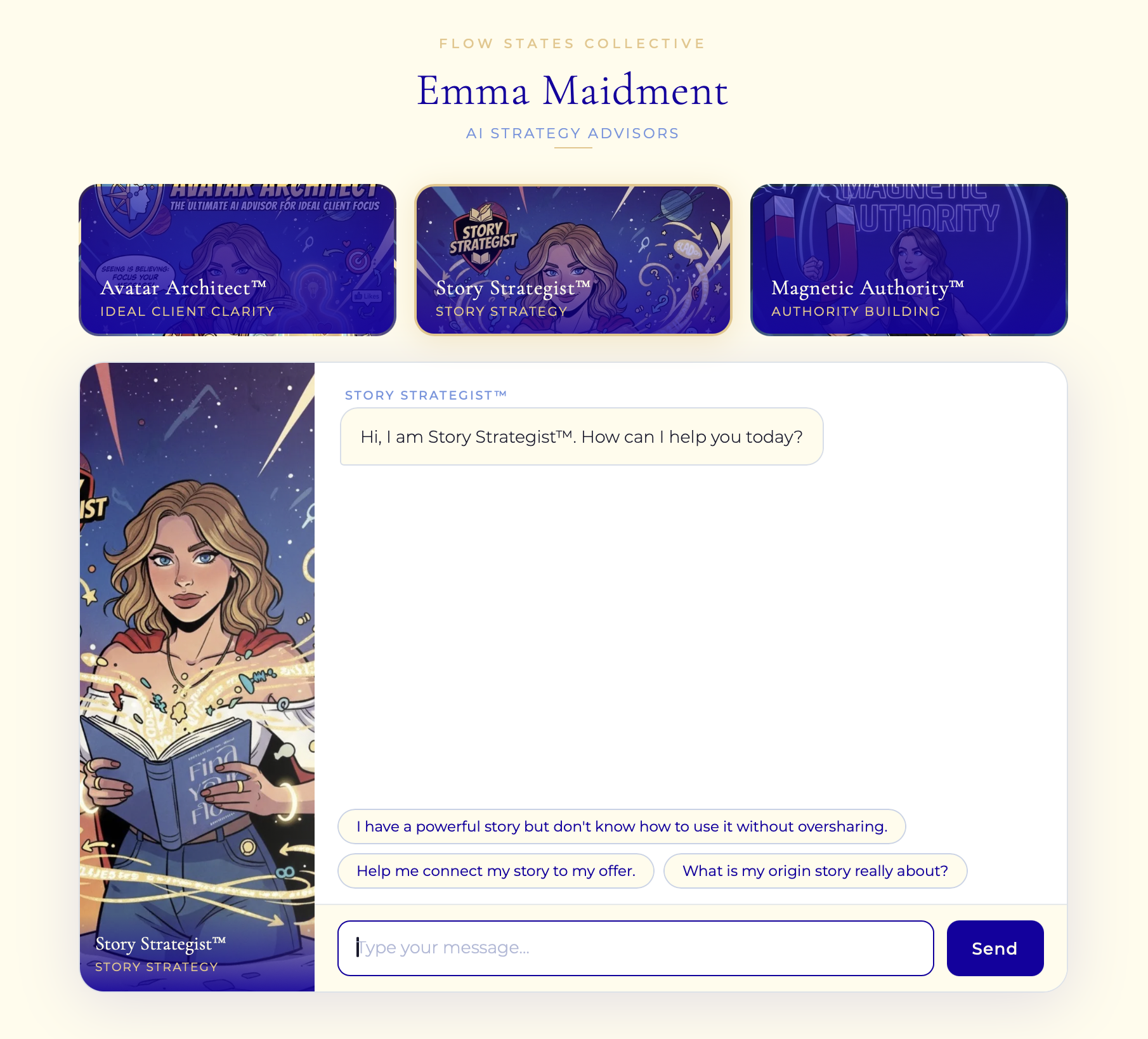
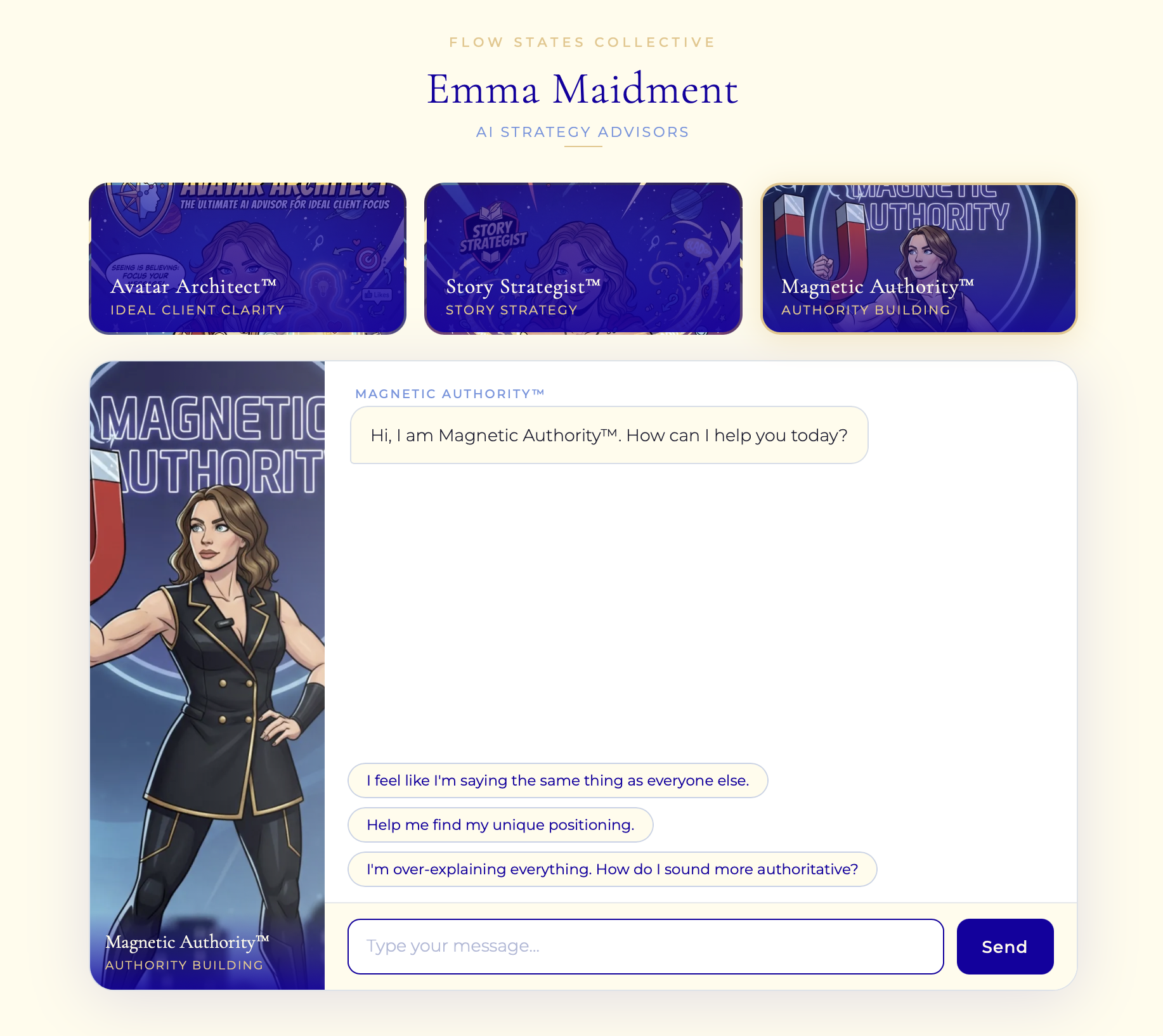
A fully custom, branded AI chat platform powered by the Anthropic Claude API — deployed on Emma’s own subdomain with her colours, fonts, and bot character art. Two AI advisors built on her exact methodology and language. A credit-based monetisation model ($17 for 50 messages, $9 top-up) with a complete purchase-to-access automation requiring zero manual work from Emma. When someone buys, a unique magic link token is generated, stored in Supabase, and emailed to the customer automatically — they click the link and land directly in the platform with their credits loaded.
The platform also serves as the top of a funnel toward Emma’s $497 strategy session — free users get 10 messages before being prompted to book or purchase access.
Tech Stack
- Anthropic Claude API (claude-sonnet-4-6) — powers both AI advisors
- Node.js + Express — backend server, session management, rate limiting
- Supabase (PostgreSQL) — credit token storage and balance tracking
- Supabase Edge Functions — serverless credit API (create, activate, deduct, topup)
- Railway — hosting, auto-deploy from GitHub, custom domain, SSL
- n8n — purchase webhook handler, token generation, GHL contact update
- GoHighLevel — CRM, product pages, checkout, email automation
- Stripe (via GHL) — payment processing
- Vanilla HTML/CSS/JS — fast, on-brand frontend, mobile responsive
Key Decisions
Edge Function Architecture
The original plan connected the Railway server directly to Supabase using environment variables. Railway’s container caching caused the variables to not be injected reliably — the server kept crashing despite the vars being set in the dashboard. The fix was to abstract all Supabase operations into a Supabase Edge Function. The server makes simple authenticated HTTP calls to the function, which has native database access. This eliminated the Railway dependency entirely and created a cleaner, more reusable pattern for future builds.
Two-Workflow GHL Split
Rather than one GHL workflow that waited on n8n to respond before sending the email, we split into two. Workflow 1 fires on purchase and sends the webhook to n8n — fire and forget. Workflow 2 watches for the ai_advisor_link custom field to be populated and sends the email when it detects the change. This made the system more resilient and means a slow n8n execution never holds up the customer experience.
Magic Link UX Over Login
No account creation, no password, no login screen. Each purchase generates a unique token embedded in a URL. The customer clicks the link in their email and lands directly in the platform with their credits loaded. Existing coaching clients get a permanent link using their access code as the token — same clean experience, unlimited access.
Outcomes
Over 20 beta users validated the concept — many asked to pay even when it was a free ChatGPT Custom GPT. The new platform converted that demand into an actual product. The end-to-end purchase flow is fully automated: purchase → token generated → Supabase updated → GHL contact updated → magic link email sent → customer lands with 50 credits ready. Emma does nothing manually. Users consistently reported significant clarity on their brand and story positioning after a single session.
What I’d Do Differently
- Start with Edge Functions for all external API calls. Any time the application server needs to talk to a database, wrapping that in a serverless function removes the environment variable dependency on the host. Would have saved several hours of debugging.
- Key/value body parameters in n8n from the start. The raw JSON body editor has a persistent bug that caused multiple failed executions. Key/value parameters are more reliable for dynamic values.
- Build the post-purchase flow token-first. The initial thank you page had a button linking to the chat without a token — meaning paid customers could accidentally land on the free tier. Always design the post-purchase UX with the token in mind from day one.
Assets
- Live Platform
- Sales Funnel
- GitHub Repo (private)
Screenshots
Built by Tyson Venables — Flow Os | Flowstates Collective